
RTC Clearance Online – Requirements, Fees, Validity & Online Process 2026
If you have been asked to get an RTC clearance and are not sure where to start, you are not alone. Many Filipinos need this document when applying for a job application, visa requirement, board exam, or legal process. It can feel confusing at first because not all Regional Trial Court branches work the same way, and the requirements can be a little different depending on where you apply.
This guide covers everything you need to know: what an RTC clearance is, how it differs from other clearances, how to apply online or in person and what documents to bring.
What Is an RTC Clearance?
An RTC clearance is an official certificate issued by the Office of the Clerk of Court (OCC) of the Regional Trial Court (RTC) of the Philippines. It confirms whether or not you have any pending, ongoing, or previously filed civil or criminal case within that specific court’s area. The clearance checks the court’s official records and confirms that you have no pending criminal or civil cases under that RTC, no active court orders against you, and your name does not appear as an accused in any case file in that area.
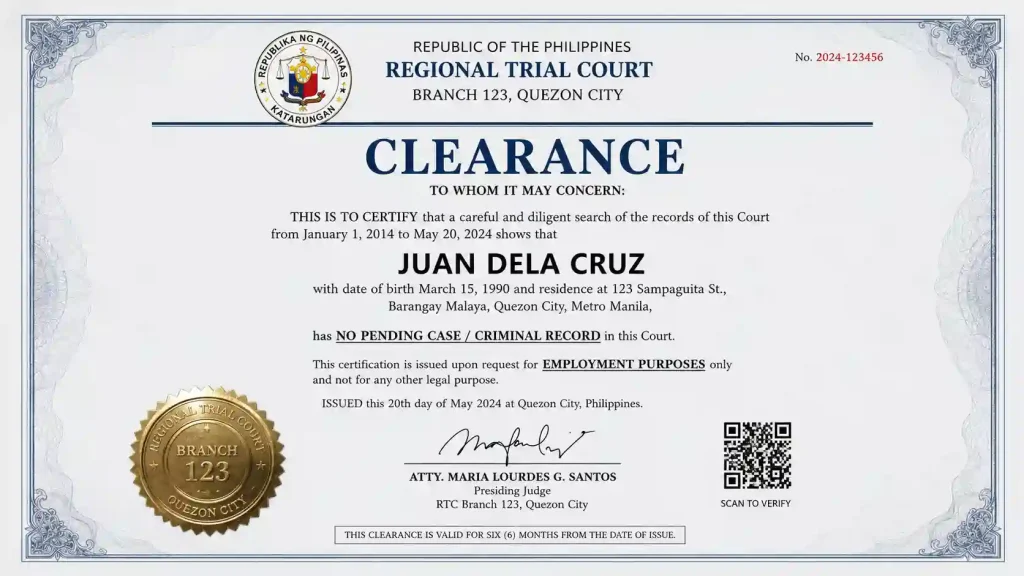
A valid RTC clearance confirms that:
Without a valid RTC clearance, some institutions may reject your application.
How to Get RTC Clearance Online or In Person (Step by Step)
Before performing an RTC clearance application, make sure you have all the required documents ready.
Step 1: Find the Right RTC Branch
Go to the RTC branch that covers the area where you live or where a case could have been filed under your name.
You will need:
Step 2: Get Your Community Tax Certificate
Step 3: Get NBI or Police Clearance
Step 4: Prepare All Your Documents
Gather all required documents including:
Step 5: Book Online or Visit the RTC Branch
Bring your valid IDs and application form.
During your visit, submit the following at the Clerk of Court’s office:
Step 6: Pay the RTC Clearance Fee
Pay the fee through available payment options:
Step 7: Wait for Processing
Processing takes as little as 20 minutes if documents are complete. Complex cases may take 3 to 7 working days.
Step 8: Claim Your RTC Clearance
After successful processing, you may claim your clearance:
RTC Clearance Requirements
Bring everything listed below on your first visit to avoid going back a second time. Here are the documents you need to prepare.
Cedula (Community Tax Certificate)
You cannot get a court clearance without a current Cedula.
Valid Government-Issued ID
Bring original and photocopy. Accepted IDs include:
Make sure your ID is not expired before applying.
Barangay Clearance & Documentary Stamp
Issued by your barangay secretary as proof of residence. Documentary Stamp costs around P30 to P50.
If the Clearance Is Issued Successfully
You will receive your RTC clearance certificate confirming you have no pending cases on record.
If a Case Is Found Under Your Name
The court will not issue a clean clearance. You can request a certification of case status instead.
This usually means:
RTC Clearance Validity and Renewal
The validity of an RTC clearance depends on the branch that issued it. There is no single rule that applies to all branches across the country.
Step 1: Check the Validity Period
Step 2: Confirm With the Requesting Office
Step 3: Renew if Expired
Step 4: Pay the Renewal Fee
Verify that the renewal details match your records, including:
If the information does not match, your clearance may be invalid. Renewal follows the exact same fee structure as the original application.
How to Verify Through the Issuing RTC Branch
If you need to confirm an RTC clearance, you can contact the court branch that issued it directly.
Step 1: Find the Branch Contact Information
Search online for the RTC branch’s:
Step 2: Contact the RTC Branch
You may:
Explain that you want to perform an RTC clearance verification check.
Step 3: Provide Certificate Details
Prepare the following:
The RTC branch can confirm whether your certificate is authentic.
Common Reasons Why RTC Clearance Applications Fail
Sometimes users experience problems during the RTC clearance application process. Here are the most common causes.
Incomplete Requirements
Missing documents such as your:
can cause your application to be rejected on the spot.
Applying at the Wrong Branch
Going to a branch that does not cover your area will result in no record being found.
Pending or Active Court Cases
If a case is found under your name, a clean clearance will not be issued until the matter is resolved.
Incorrect Personal Information
Occasionally, name misspellings or wrong birth dates on your documents can cause processing delays.
Common Reasons Why People Need an RTC Clearance
Following are the situations where you might need a verified RTC clearance certificate.
1. Overseas Work Applications
Many foreign employers and recruitment agencies require an RTC clearance as part of a Philippine court background check. This is especially common in:
Employers use RTC clearance to ensure applicants have no pending court cases on record.
2. Visa and Immigration Applications
Embassies and immigration agencies often ask for an RTC clearance alongside an NBI Clearance. An RTC clearance proves that you have no active court cases filed against you within Philippine jurisdiction.
3. Firearms and Security License Applications
Government agencies require an RTC clearance before granting regulated licenses, especially for:
4. Government Job and Professional License Applications
Many government positions and professional licensing boards require an RTC clearance for:
An RTC clearance helps confirm a clean legal background required for public service and licensed professions.
5. Legal and Property Transactions
During certain legal proceedings or property deals, authorities may require an RTC clearance to confirm you have no legal encumbrances or court orders that could affect the transaction.
What If You Have an Existing Case?
If the court finds a case under your name during the record check:
MTC and RTC Clearance: What Is the Difference?
Some applications ask for clearance from both the MTC and the RTC:
You need to apply at each court separately. The combined MTC and RTC clearance is usually required for firearms licensing, sensitive government jobs, and thorough background checks by employers.
Frequently Asked Questions
RTC Clearance FAQ
Conclusion
An RTC clearance is one of the more important but least talked about documents in the Philippines. It goes deeper than an NBI or Police Clearance by checking the actual case records of the Regional Trial Court in your area. Whether you need it for overseas work, a board exam, a firearms license, or a government job, the process is not hard as long as you go to the right branch and bring complete documents.
The most important things to remember: get your Cedula first, go to the correct RTC for your area, bring everything on the requirements list on your first visit, and apply with enough time before your deadline since validity periods are short.


